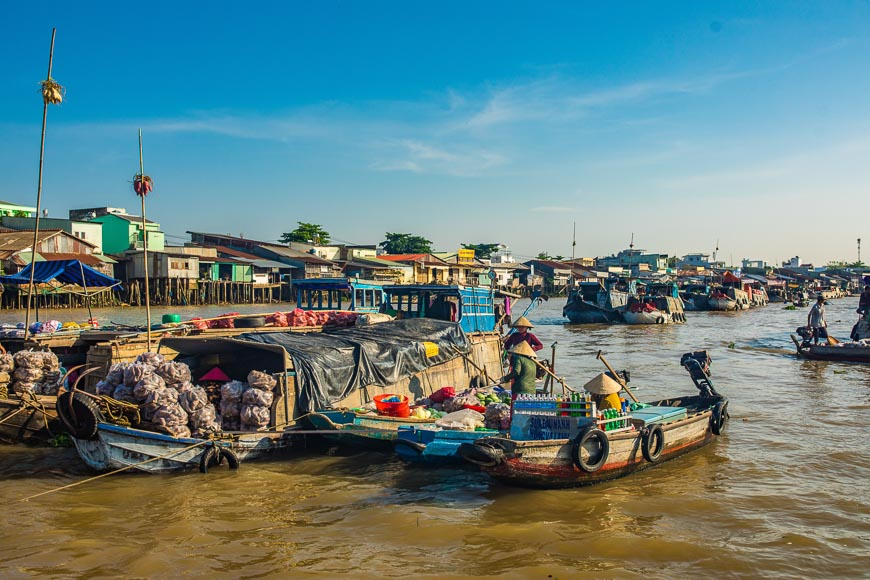
Near Ho Chi Minh City – Sailing among the floating markets and traditional villages on the Mekong Delta is high up most Vietnam lists, but the nearby Cu Chi Tunnels are not to be missed either. If you’re feeling brave crawling through the pitch-black tunnels will provide a good idea of the harsh reality experienced by Vietnamese soldiers. Safely above ground, you can peruse the booby trap exhibition, which somehow scares us less.
Nha Trang – Around 7.5 hrs north of Ho Chi Minh City by train, the seaside retreat is popular for its idyllic beaches, scuba diving and spas. It’s also home to an island theme park, Vinpearl Land, which is best reached via a scenic cable car ride across the bay. A visit to the impressive Po Nagar Cham Towers will be in order afterwards to calm any residual endorphins.
Hoi An– This is the place for anyone who likes to shop, with markets galore selling food, souvenirs, clothes and local crafts. It’s also one of the few places you’ll get a chance to take a ride in a traditional bamboo basket boat and bob along like the local fishermen.
Phong Nha-Ke Bang – About two thirds of the way from Ho Chi Minh City to Hanoi, near the city of Dong Hoi, is Phong Nha-Ke Bang National Park. Scrambling around the world’s largest cave should be top of your list there, but a walk through the surrounding jungle will suit any animal-lover.
Lan Ha Bay – Swap the main part of buzzing Halong Bay for peaceful Lan Ha Bay, and you’ll be rewarded with equally picturesque views – minus the crowds. Larger boats can’t access the area, but a smaller Junk Ship cruise will get you to those secluded spots where you can strap on your life jacket and go kayaking in safety.
Slovenia is one of Europe’s least-visited countries overall for international travel – but we’re here to shake the extraordinary capital of Ljubljana in your face and tell you why that needs to change.
Ljubljana is a small city with a young vibe – about a sixth of the population is taken up by its 50,000 students – and a complex history that dates back to the Roman era.
And in wintertime, Ljubljana becomes…look, we’re going to resist the urge to use the words ‘fairy-tale’, but there is something particularly charming about its snow-capped architecture, its splendid Christmas lights and markets, its outdoor ice skating, skiing day trips, and – yes – its massive outdoor New Year’s Eve celebrations.
For us, though, the real trump card is Ljubljana’s quite frankly ludicrous artistic scene – over 14,000 cultural events take place in the city every year, ensuring that you’ll never be at a loose end on a rainy day.
Founded as a squat in an old army barracks in 1993, the Metelkova neighbourhood is a punky cultural centre and network of clubs, and it’s rightly famous as the city’s alternative, underground heart. (The neighbourhood hostel, Cecilia, is an old prison that welcomes guests into its 20 colourfully-designed cells.)
For travellers whose raving days are long behind them, however, the city centre also holds a wide variety of museums, concert halls, theatres, and much, much more.
If you can’t make it for Christmas, then we’d head to Ljubljana in February, in time for the Pust or Karneval celebrations, where in Slovenian tradition fearsome masked figures parade to chase the winter away. (In Ljubljana, the parades are led by the city’s mascot, the green dragon.)
Eating and drinking
With a heavy emphasis on pork and deliciously doughy desserts, Slovenia is a great choice for warming winter food – but Ljubljana is way too trendy to rest on its laurels. Last year, the city had 17 mentions in the Michelin Guide, with praise going out to its talented chefs fusing traditional Slovenian cuisine with Mediterranean, Thai and Japanese influences.
While we haven’t been there ourselves, we’d be tempted to take a cab out to the delightfully infamous Gostilna Skaručna, an eccentric family-owned restaurant serving traditional Slovenian cuisine just outside the city. Wash it all down with an excellent glass of Slovenian wine, local plum schnapps, or the up-and-coming local vodka – which, for some reason, has Bill Murray as its ambassador. (Maybe Lost in Translation gave him the idea?)
Bulgaria has a good amount of mountainous coverage – which means it’s showing off some of Europe’s most stunning waterfalls across its three national parks. In the north, you’ll find gorgeous glacial lakes and craggy hiking routes past ruined medieval fortresses and monasteries.
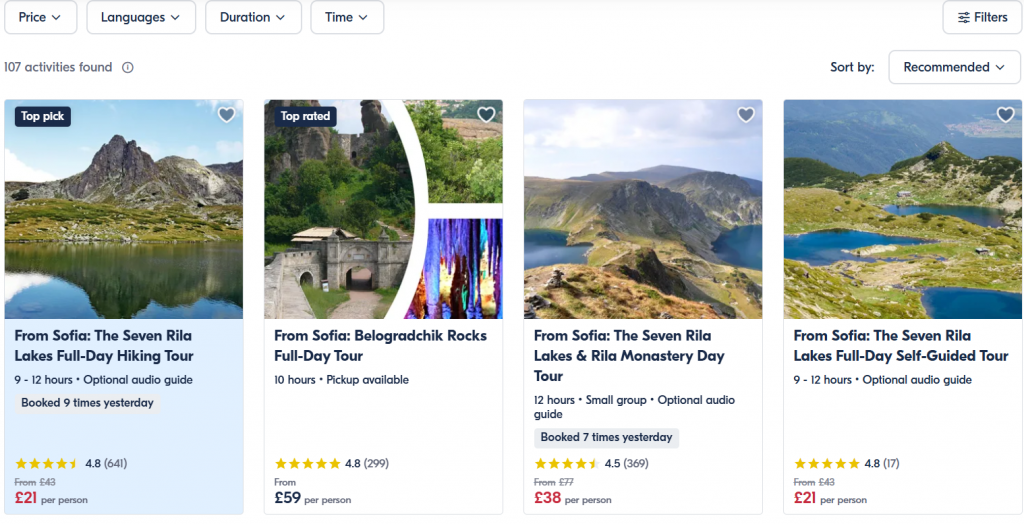
While we’d make it a priority to visit the Seven Rila Lakes or the rocks of Belogradchik (pictured above) in the mountains for some unforgettable walking trails, there are also lovely hiking options up Vitosha Mountain, less than an hour’s bus ride from Sofia.
In the south, you’ve got charming coastal towns like the UNESCO-recognised Nessebar – or if you want to really get away from it all, head to the completely undeveloped and peaceful Pasha Dere beach for some Black Sea RnR.
Only around 300,000 foreign tourists visit Gdansk on Poland’s Baltic coast every year – compare that to the nine million visitors who descend upon Brugge every year.
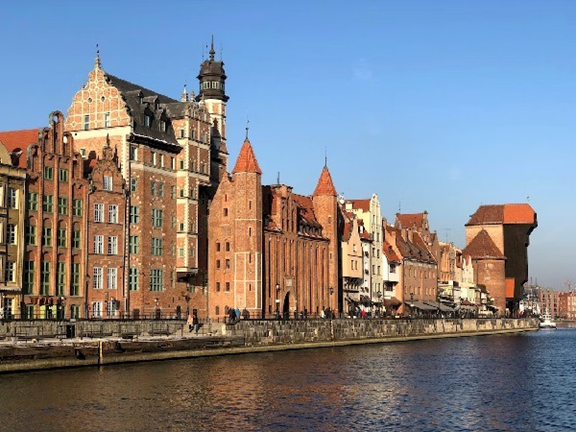
It’s a huge pity; the city boasts a magnificent old town with some stunning Mannerist architecture and a number of lush walking routes and cycling trails to keep you occupied.
And in the autumn, Gdansk (when it isn’t raining) comes alive in colour – Poland is famous for its ‘golden autumn’ in October when the beech forests are particularly gorgeous. It’s a great time to drop in on Gdansk’s scenic 10-hectare Oliwa Park, which features stunning beech alleys, duck ponds, and the Groty Szeptów, or ‘Whispering Caves’.
Eating and drinking
Traditional Polish pierogi are popular in town, as are potato pancakes and rosół meat soup. For a properly authentic experience, head to one of the city’s ‘milk bars’ – low-cost diner-style restaurants popularised during the Soviet era. (The folks at Nothing Familiar have some tips here on the best milk bars to visit.)
And to drink? Well, there you’re spoiled for choice. The city has an almost ludicrous volume of beloved craft beer bars, but there’s also Polish vodka ( remember to toast), the cherry liqueur wiśniówka, and Gdansk’s resident fancypants drink Goldwasser, containing gold flakes and made famous by the European royals who believed it held alchemical properties.
Perhaps most surprisingly to foreigners, winemaking has a centuries-old history in Poland and it’s seeing a resurgence across the country, mostly led by talented enthusiasts – Gdansk has one such ‘amateur’ winery, the Winnica Modzrew, which is well worth checking out.
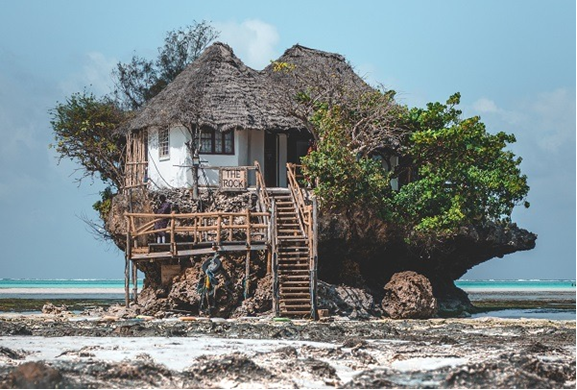
Zanzibar’s famous ‘The Rock’ restaurant – a stunning place to take photos, although maybe not the cheapest place to eat on the archipelago!
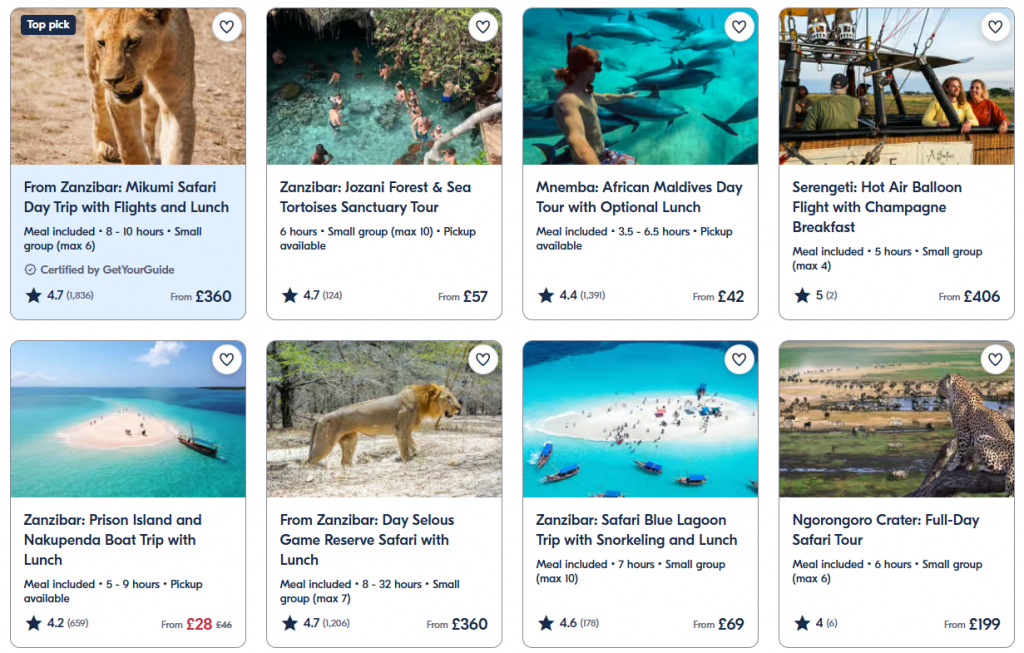
Getting in a safari on a budget
Tanzania is generally a cheap place to travel ( Budget Your Trip estimates that the average traveller will spend £18 per night on meals and £70 on accommodation) – however, there’s one notable exception.
Yes, the country’s safaris are infamously costly, and they’re likely to eat heavily into your budget thanks to a combination of expensive national park entry fees (the Serengeti and Nyerere National Parks will charge £60 per adult entry alone during the peak season plus a number of add-on costs – high fuel prices, vehicle and guide hire, and accommodation costs.
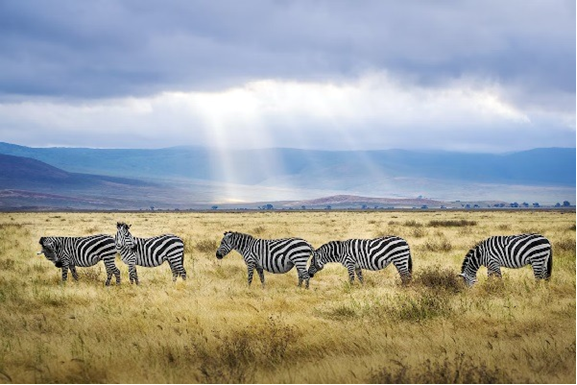
Ngorongoro Crater was actually named by the Maasai after the sound of cow-bells, quite beautifully.
There are a few ways to ensure you get to see the out-of-this-world natural beauty of Tanzania’s national parks (and why would you want to miss out?) while still cutting back on costs, however:
Consider when you travel. The high season of May to October will be expensive, particularly during the Great Wildebeest Migration. The low season (March to May) is cheaper for a very good reason, with the heavy masika rains falling throughout these three months. But in January to February, Tanzania experiences a second, shorter dry season which may be… very slightly cheaper, although the entrance fees themselves will remain steady.
If you’re willing to rough it, you could spend the night in one of the Serengeti’s six public campsites rather than at a fancy lodge, and simply pay the camping fee at the entrance. Don’t expect five-star accommodation – the toilets in particular see a lot of complaints online – but you’ll certainly get an authentic safari experience for less (and likely hear a few wild animals in the night!). Pimbi Camp appears to be the best rated campsite out of the six.
In theory, you could also cut back on guide costs by simply renting your own 4×4 for the day and drive yourself around the parks (you’ll still need to pay the vehicle fee). However, we’d strongly advise against this, for a few hopefully obvious reasons! You’ll save a little money, but you’ll be losing out on expertise, driving skill, and unless you speak Swahili and have a working two-way radio, you’ll likely struggle to figure out where the animals actually are.
For budget safaris, we’ve seen a number of travellers recommending Krisha Africa Safaris, based out of Arusha, for a combination of reasonable rates and quality experience, so that might be a great place to start.
And on a related note – we’d definitely note that a Kilimanjaro climb is likely out of the scope of a budget holiday (and beware of unscrupulous operators who claim they can get you up the mountain for cheap)!
Rest and restaurants in Zanzibar
For good budget accommodation in Zanzibar, we’ve seen a lot of buzz and positive traveller feedback around New Teddy’s On The Beach, a hostel that’s based (as you’d imagine) on the Jambiani beach out on the eastern coast, about a 30-minute drive from Jozani Forest and its famous red Colobus monkeys.
New Teddy’s has private rooms with their own en-suites available – a double will set you back about £50 per night – plus a range of beach activities, and the usual local guides on hand to organise scuba diving, tours of Stone Town’s famous bazaars and ornate doorways, or visits to Zanzibar’s spice farms. Guests rave about the relaxing, laid-back vibes (and ample hammocks) – sounds ideal.
If you’d rather stay in the bustling heart of Zanzibar City itself, Shoki Shoki House is another well-rated and cheap hotel located in Stone Town – just remember that if you’re visiting during Ramadan, some of the restaurants and markets in the city may be closed! (Also, one of the city’s famous sights, the ‘House of Wonders’ and Palace Museum, has been sadly closed since 2020 due to a partial collapse.)
When it comes to getting around – both in Zanzibar or on the mainland – the true budget option is the dala-dala. These open-backed mini-buses can be chaotic and crowded, but they can cost less than a pound per journey ( just watch out for con-artists). If you’re not feeling quite as adventurous, you can speak to your hotel about private mini-buses or car hire.
Yes, it’s true, visitors to the Dead Sea may often end up in Jordan’s cluster of plush five-star Crowne Plaza and Marriott resorts rather than seeing the breadth and width of the country.
But a number of Jordanian institutions have also put an astonishing amount of effort and energy towards supporting and sustaining responsible tourism over the past 50 years – and that makes it relatively straightforward to plan a trip where your money is actually going back to local communities.
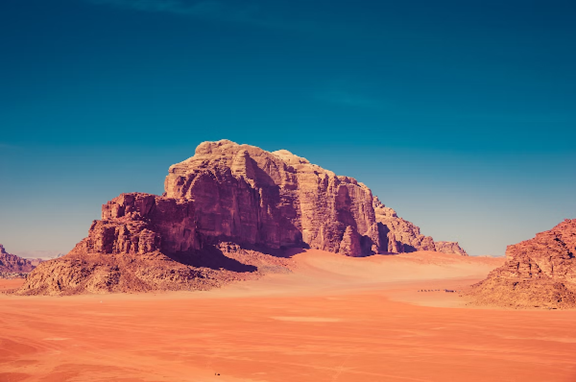
For instance, if you head out to the stunning Wadi Rum valley, you’ll find that virtually all of the tourist enterprises are run by local Bedouin families from the Zalabia tribe, from day tours to overnight camps, and collectively organised by the local Rum Tourism Cooperative.
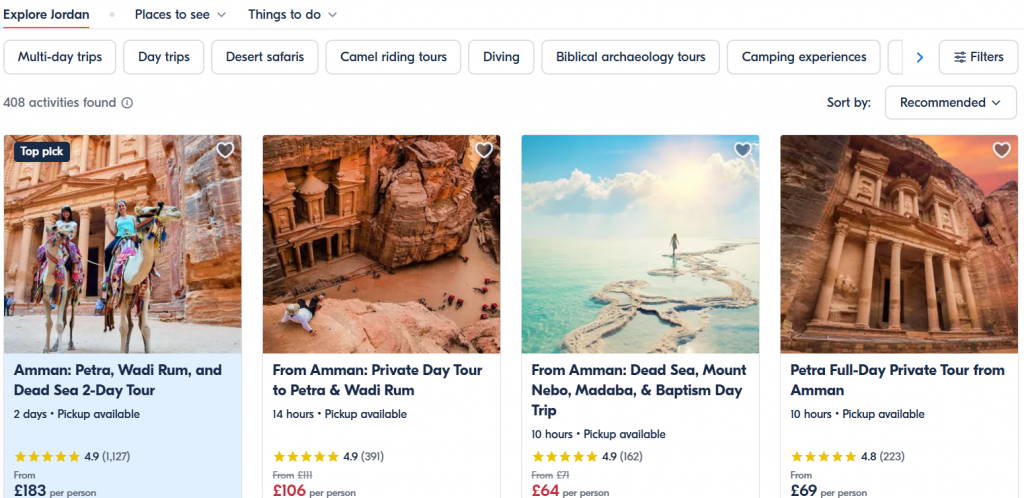
Even when booking a visit to ultra-popular Petra, it’s not too difficult to skip past the big international tourism agencies and support brilliant local guides and homestays instead – one of the best-rated private tours on TripAdvisor is run by Abdullah Nawafleh, who grew up in the area working on the excavation site. (Guests rave about Abdullah’s brilliant knowledge of Petra, his love of Jordan, his kindness, and his singing ability.)
In the north of Jordan, Baraka Destinations organises tours and experiences run by locals (from archaeological hikes to basket-weaving and beekeeping).
And even if you head out for a hike across the many isolated wadis, canyons and waterfalls of the Dead Sea Trail, you could end up stumbling onto one of the handicraft workshops and shops which are run by Wild Jordan, an offshoot of Jordan’s longstanding Royal Society for the Conservation of Nature, with the aim of supporting craftswomen from local communities.
Back in 2018, the Jordanian tourism board actually created its own official ‘Meaningful Travel Map’, which encourages travellers to visit community-run sites, hotels, guest-houses and social enterprises across the country.
The map isn’t exhaustive, but it’s a great place to start and offers a wide range of different possibilities for your next trip (or your next tips for European tourists).
After months of restrictions and staycations, the world is once again our oyster, and you may be about to embark on your first far-flung holiday since the pandemic began. But while being filled with excitement for that well-earned break, you might also be battling anxiety about travelling for the first time. Here, we lay out our top tips on how to stay well and get the most out of your long-awaited break.
Figures show that spending on hotels, resorts and holiday accommodation rose 16.6% in April 2022, compared with the same month in 2019, as we all look forward to some well-deserved time off.
But the pandemic means that, for lots of us, there is an understandable element of anxiety about travelling again for the first time.
The potential for restrictions changes, lowered immunity and virus transmission can make, what should be an exciting prospect, a real headache. And with the pandemic triggering a 25% increase in the prevalence of anxiety and depression worldwide, it’s perhaps not surprising that travel worries has crept in alongside.
But this should not be holding you back.
Worker burnout is at an all-time high and it’s important you take some quality, relaxing time out. After an extended break from travel, many of us could also do with a reminder of how to stay well (and how that may be a bit different now), particularly as research suggests that up to 79% of people get ill during travel or on arrival.
So, here’s our expert guide to being stress-free and healthy on your next get away.
Plan for every eventuality
First, check if you need any jabs for your destination. “Travel vaccinations should be planned a minimum of eight weeks prior to travel, as some may need several doses spread out over a few weeks or months,” said Dr Verity Biggs from H3 Health.
“The main travel vaccines available on the NHS include polio, typhoid, hepatitis A and cholera. It is essential to plan in advance, as although it may feel urgent to get them done if you have planned a trip last minute, it isn’t classed as urgent for the NHS,” warns Biggs, who also recommends making sure you are up to date with any health checks and making sure you have your usual supplies of medication for travel. Head to NHS site FitForTravel to find out what you need.
Travel vaccines are also available via some health insurance plans, such as Vitality’s Worldwide Travel Cover, which allows people to claim up to £100 each year on a range of vaccinations, including anti-malarial, typhoid and cholera.
Wash your hands in airport hotspots
Due to a reduction of holidays and travel, concerns have risen that this could have an impact on our immune systems. So, does this make us more vulnerable to illness while on holiday?
“When our immune system doesn’t ‘see’ viruses for a prolonged time, our immunity tends to wane, which means we may get a more severe form the next time we are exposed,” said Immunologist Dr Jenna Macciochi, author of Your Blueprint for Strong Immunity.
“But two years of restrictions is very short in terms of immune function, which is built up over your entire lifetime,” she explained.
We still, however, need to maintain a certain level of vigilance when it comes to hygiene, Biggs warns.
“Being in close proximity to others and touching different surfaces will spread germs,” she said. “We still need to remember the advice to wash our hands regularly, use hand sanitiser and cover our faces when coughing and sneezing.”
Pandemic-proof yourself
So, the good news is your immunity shouldn’t be affected. But there are still extra precautions that should be taken, particularly if you’ve had Covid-19.
The risk of deep vein thrombosis can be elevated for up to three months post-infection. So, if you’re travelling by plane, try to move around during the flight as much as possible, don’t cross your legs, stay hydrated and consider compression socks. It might also be a good idea to take a small dose of aspirin – this helps thin your blood, making clots less likely.
If you’re still concerned about Covid-19 when you get to your destination, do whatever makes you feel comfortable: carry hand sanitiser, wear a mask (particularly in enclosed indoor spaces, such as public transport), and do your research, many businesses will publish their Covid-19 policies on their websites, so you can have peace of mind you are going somewhere you feel safe.
Pack a first-aid kit
As well as a good book and a deck of cards, bring along some health must-haves.
Biggs recommends buying a pre-prepared first aid kit, containing the usual suspects such as: gloves, plasters, bandages, antiseptic wipes and antiseptic creams, but also bringing rehydration sachets, over-the-counter painkillers and insect bite cream.
“Also pack probiotics, known to be helpful for traveller’s tummy. Look for Symprove, which is water-based food supplement beneficial for the gut, and the ‘good’ bacteria (Lactobacillus casei, acidophilus and plantarum as well as Enterococcus faecium) added.
Avoid tummy troubles
So, you’ve got your probiotics, but do also remember to follow all the usual rules when it comes to avoiding holiday tummy troubles:
Go for fruit that needs to be peeled,
Avoid salads that could have been washed in contaminated water,
Be cautious around shellfish,
Check that you can drink the local water, and if you can’t, don’t have ice in your drinks and use bottled water to brush your teeth.
Be clever at buffets – food that has been sitting around poses a greater risk of food poisoning, so choose dishes that are piping hot.
If you do fall sick, Biggs recommends seeking medical attention if your symptoms are severe. “Symptoms should normally only last three to five days and get better on their own without needing treatment,” she said.
And remember, emergency treatment costs and repatriation expenses are covered under Worldwide Travel Cover, up to £10m.
Know when to worry about a bite
We may be used to the critters we face at home, but different creatures may bite us abroad.
“Insect bites are common in many parts of the world, but monitoring the bites for changes is recommended,” said Biggs.
“It is common for a bite to become red and itchy, but if the redness is spreading, or becoming more painful and swollen, seek medical advice. Use creams formulated for bites, try to avoid scratching them and keeping them cool can all help.”
To avoid bites, the NHS recommends applying insect repellent that contains 50% DEET, staying away from strongly perfumed personal care products that can attract bugs, being careful around flowering plants and stagnant water, and keeping food and drink covered outside.
Stay safe in the sun
It’s always important to protect ourselves from the effects of the sun. And if you haven’t been abroad anywhere hot for a couple of years, you may need to redouble your safety efforts, both from a skin perspective and to avoid heat stroke or dehydration.
“Keeping hydrated and avoiding the midday sun is key to avoiding too much sun and heat,” explained Biggs.
“Stay out of the direct sun from noon to 3pm and wear a hat. Sun cream should be a minimum of SPF30 and needs to be reapplied regularly throughout the day, remembering areas of the body which can be easily forgotten – your ears and feet, for example.”
Be open to change
Above all, be kind to yourself. You might not want to do the things you used to on holiday – visiting crowded tourist attractions, for example, and that’s fine.
Instead, look to connect with nature, include some self-care (we’re not saying no to a spa day), or fit in some activities that get your body moving – all will help you feel your best.
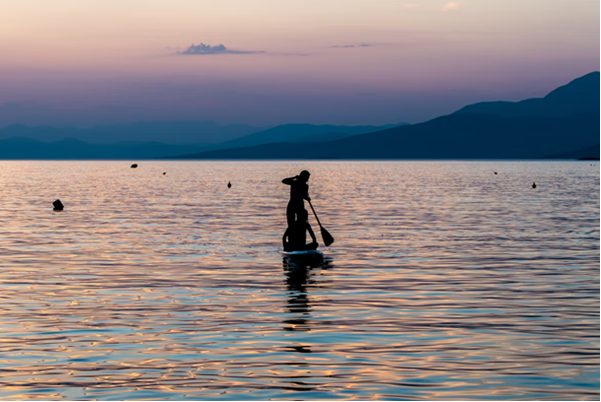
Paddleboarding requires different conditions to surfing – you’ll probably be looking for calmer waters and fewer waves.
And Costa Rica is rightly famous for the quality of its surf and sealife, but it’s also a very convenient consideration for getting the water conditions just right, since its two coastlines will see favourable water conditions at different times of the year.
The western coast, exposed to the Pacific Ocean, will see powerful waves during the ‘green season’ (May-November), while the eastern coast, facing the Caribbean, will perk up from December-March for the dry season. So simply pick your coast depending on your sport – or do a cross-country trip to get a bit of both.
On the western coast, Tamarindo is well-known as one of the country’s most popular spots for watersports, with plenty of surf schools and paddleboarding classes or beginners – and just as many crowds.
But instead we’d take a trip over to the trendy town of Montezuma on the slightly more remote (and thus, less busy) Nicoya Peninsula. It’s got a huge nature reserve, a ton of reliable beaches, world-class restaurants, and a beautiful-but-possibly-haunted cemetery island if you happen to be into that sort of thing.
From there, head south along the Pacific coast of Costa Rica and eventually you’ll come to the Osa Peninsula – and the waters of the sheltered Golfo Dulce.
This extraordinary ecosystem (actually one of the world’s few tropical fjords) offers calm waters for paddleboarding, as well as visits from humpback whales, whale sharks and more.
Those peaceful vibes are perfect for testing your mettle with a bit of paddleboard yoga, too. Just be careful not to drop the downward dog if a friendly whale bumps into your board.
While you’re in the vicinity, check out the absolutely stunning Golfo Dulce Retreat – it’s a fully-sustainable eco-lodge operating on its own power grid, only accessible by boat and sitting in a plum position between the rainforest and the beach.
Dubrovnik’s stone walls, Diocletian’s Palace in Split, the island of Hvar, the Pula Arena, Zagreb’s Upper Town and Plitvice Lakes National Park are some of Croatia’s main attractions tourists flock to every year.
But Croatia is full of hundreds of gems around the country and there are many attractions tourists aren’t sometimes familiar with. Below are just 10 interesting spots to check out away from the main attractions.
KLIS
Klis
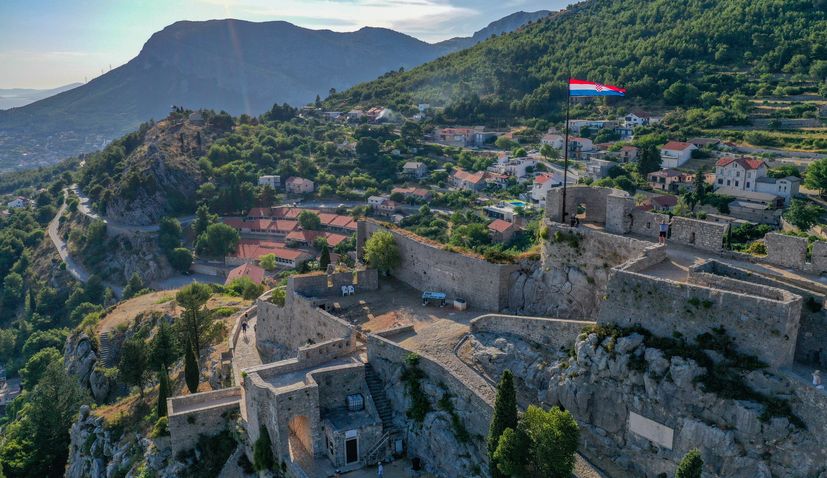
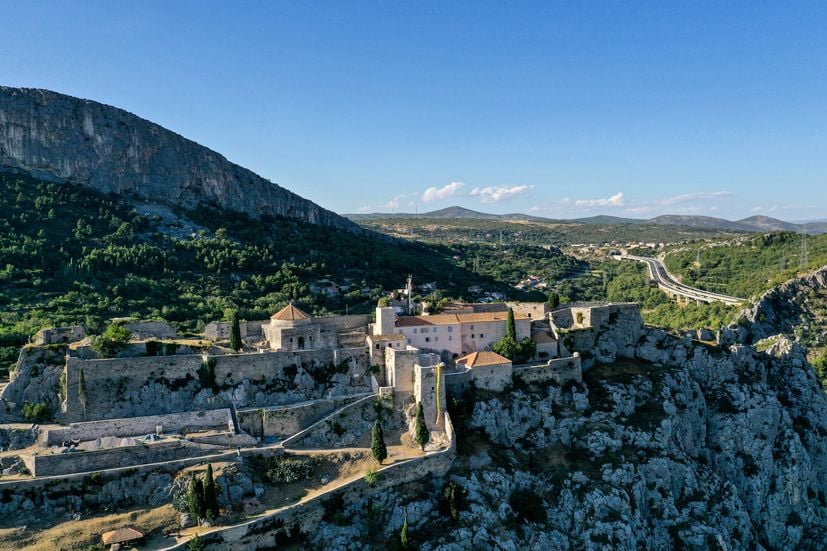
Klis Fortress is located just northeast of the Dalmatian city of Split. When the Ottoman wars were raging through Europe the ancient Illyrian stronghold was expanded into Klis Fortress. The 2,000-year-old medieval fortress served as a defense spot in Dalmatia.
It was also the seat of many Croatian kings and dukes, from the 9th century Duke Mislav, under the reign of Duke Trpimir to the first Croatian king, Tomislav. It was later ruled by the famous Šubić family. The fortress is best known because of the 16th-century defense against the Turkish invasion that lasted for more than 20 years. At one point in history, Klis was under the control of the Templar knights.
Klis
Because of the great historical value, today the fortress is a museum. The beautiful fortress follows the natural structure of the hill and is of great value as an example of defensive architecture. Its spectacular position, overlooking the surrounding area, the town of Split and the sea, was used as a part of Meereen in the filming of the HBO series Game of Thrones.
SOLIN
Solin
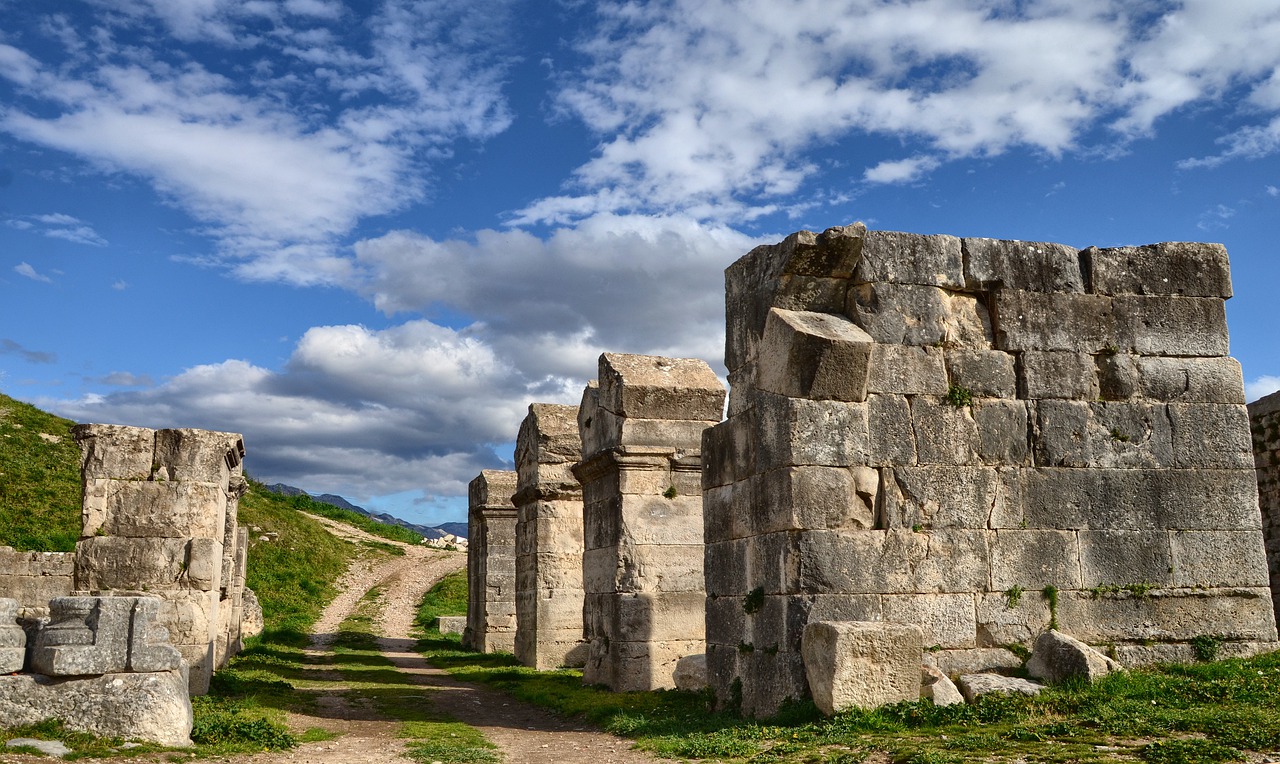
Solin is a small Croatian town with a wealth of cultural heritage. It is located just outside of Split on the Jadro river. First known as Salona, is an archeologists and archeology enthusiast’s paradise.
Solin developed on the location of the ancient city of Salona which was the capital of the Roman province of Dalmatia and the birthplace of Emperor Diocletian. The town is home to the largest archaeological site in Croatia, surrounded by gorgeous gates, temples, and an amphitheater. Many other historical locations can be found in Solin.
WALLS OF STON – STON
Ston (Photo credit: Lubenica/CC BY-SA 4.0)
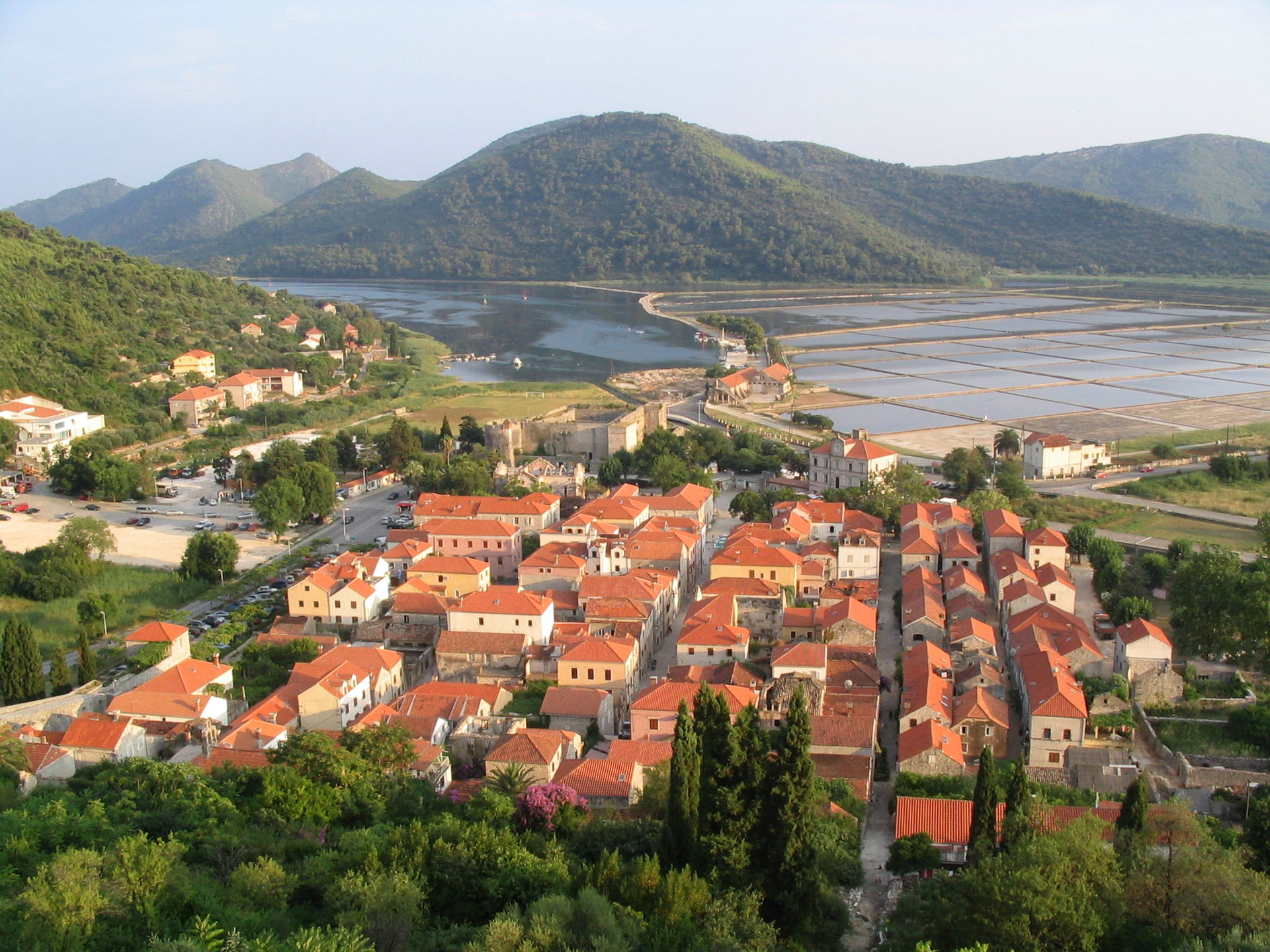
Known as the “European Wall of China”, the Walls of Ston in southern Croatia are the longest preserved fortification system in the world after the Great Wall of China.
The Walls of Ston protected the city from Ottomans for more than 500 years. Settled on the hillside, the walls and forty defensive towers look over the beautiful Adriatic sea.
PAPUK NATURE PARK – SLAVONIA
Papuk Nature Park (Photo credit: Highonsteep/CC BY-SA 4.0)
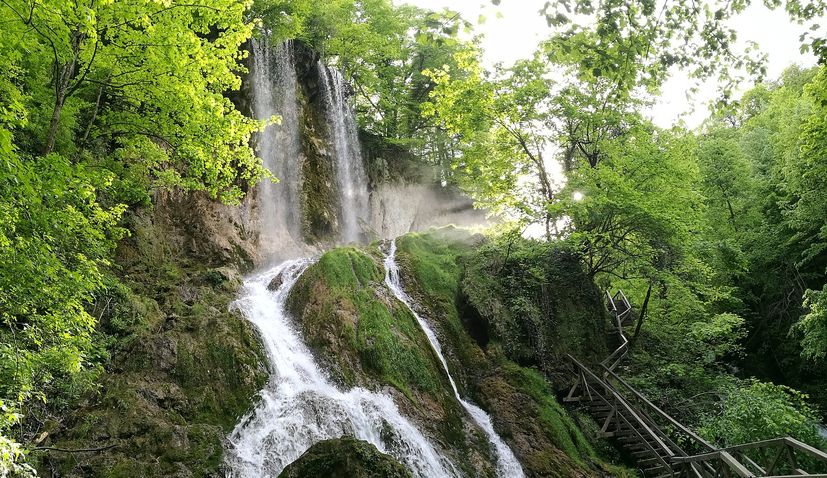
Papuk is the largest mountain in Slavonia, near the city of Požega. It is a protected area and Croatian Geopark. It is perfect for recreation – mountaineering, hiking or horse riding because its highest peak is 953 meters high. Visit Ružica grad which is the biggest Medieval fort in Slavonia and one of the biggest in Croatia.